


In the data center backup power sector, lead-acid batteries (VRLA) have served as a “reliable workhorse” for decades. However, as lithium battery technology matures and costs fall, a century-old transition from lead-acid to lithium is accelerating globally. In 2026, lithium iron phosphate (LFP) lithium battery has become the new industry standard for data center backup.
1. Time Limitations of Traditional Lead Acid
With the advantages of mature technology, low cost and high safety, lead-acid batteries have long occupied the dominant position in the data center backup power market. Previously, lead-acid batteries accounted for approximately90%-95%Lithium is only a small part.
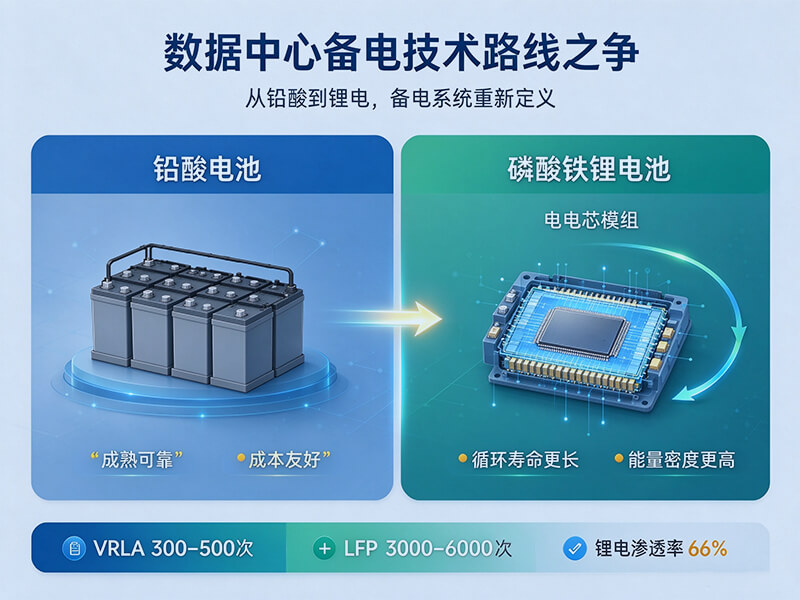
However, as the power density of data centers continues to increase, the limitations of lead-acid batteries have become increasingly prominent. The first is the short cycle life: valve-regulated lead-acid battery (VRLA) is only300-500Times, in floating charge and occasional dischargeUPSUnder working conditions, the service life is about3-5Year. The second is the low energy density: the energy density of lead-acid batteries is about30-50Wattage hour/Kilograms, volume and weight are very large. The third is the slow charging speed: a full charge requires8-12hours, it is difficult to quickly restore backup capacity in the event of multiple mains interruptions.
2. LFPTechnical advantages of lithium battery
Lithium iron phosphate battery (LFP) Beyond traditional lead-acid batteries in multiple dimensions:
3. Increase cycle life by an order of magnitude
Under the condition of good management,LFPThe number of cycles of the battery pack can reach3000-6000Times, in floating charge and occasional dischargeUPSUnder working conditions, the actual service life can reach10More than years. In comparison,VRLABattery only available300-500The second depth cycle. This means thatLFPThe replacement cycle of the battery is more than doubled, which greatly reduces the maintenance cost of the whole life cycle.
4. Volume and weight greatly optimized
LFPThe energy density of the battery can reach150-250Wattage hour/Kg, the same capacity, the volume is only lead-acid battery1/3到1/2, the weight is reduced by more50%. This is significant for data center rooms where space is at a premium——The space saved can be used to deploy more servers and improve room utilization.
5. Higher charge and discharge efficiency
LFPThe charge and discharge efficiency of the battery can reach95%Above, much higher than that of lead-acid batteries.80%-85%. More importantly, the charging acceptance: after the mains is interrupted, the lithium battery system can be restored in a short time.90%The state of charge of the lead-acid battery takes several hours to charge to the same level. This is especially important in areas with frequent power outages.
6. Penetration status: overseas acceleration, domestic start.
CICC Company pointed out that the overseas market due to the calculation of power chip power iteration faster, superimposed on the higher labor operation and maintenance costs, lead to lithium has become a certainty trend.Global Growth InsightsThe data shows that,2026Annual Data CenterUPSThe adoption rate of lithium batteries in the market has reached66%。
In contrast, the lithium penetration rate in the domestic market is still at a low level. The main reasons include: first, safety concerns, the risk of thermal runaway of lithium batteries is highly concerned in the data center scenario;LFPFull battery life cycleTCOBetter, but the initial procurement cost is still higher than that of lead-acid batteries; third, the standard specification, the design standard of domestic data center backup system is still based on lead-acid batteries.
With the gradual resolution of security issues, as well as overseasHVDC(High-voltage DC) power supply architecture gradually follow-up, the domestic data center lithium penetration rate is rapidly increasing.
3.4 Economic Analysis: Full Life CycleTCOComparison
From the initial purchase cost,LFPThe price of a battery pack is usually higher than that of a lead-acid battery of the same capacity. But from the full life cycle total cost of ownership (TCO) to see,LFPThe battery has obvious advantages:
Low replacement costs:LFPBattery life10years or more, while the lead-acid battery3-5years need to be replaced. At10During the annual cycle, lead-acid batteries need to be replaced2-3times, andLFPThe battery only needs one time. The second is low maintenance costs:LFPThe battery is maintenance-free, does not require regular water replenishment, balanced charging and other operations, reducing the cost of manual inspection. Three is the space cost savings:LFPSmall battery size, saving room space can be used to deploy moreITequipment, generating additional revenue. Four is the low cost of energy consumption:LFPThe battery has high charge and discharge efficiency and reduces energy consumption.
For large data center operators,LFPFull life cycle of batteryTCOAdvantage has become the core economic driver of lead-to-lithium.


