


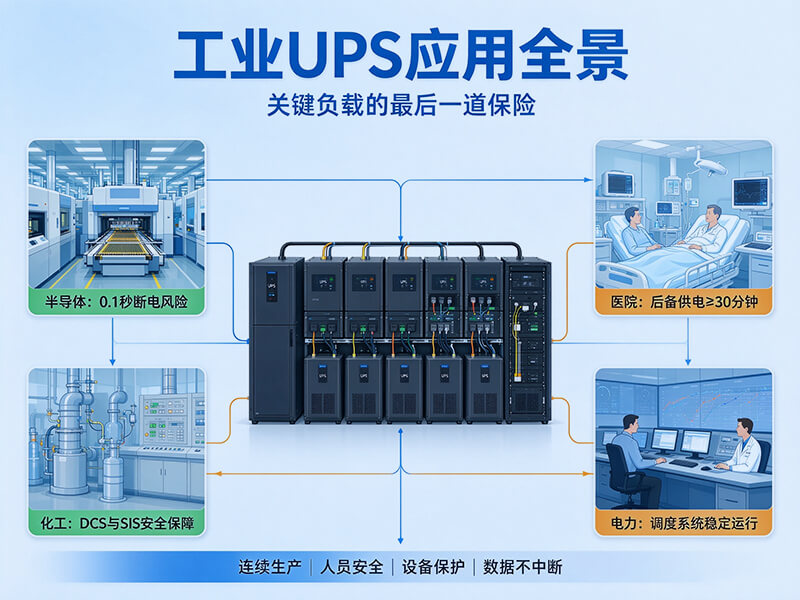
In the modern industrial system, the loss that power interruption may cause is far beyond imagination-a wafer on the semiconductor assembly line is worth hundreds of thousands of yuan, a power failure in the hospital operating room may endanger life, and a trip of a chemical device may cause a safety accident. Industrial-grade UPS is the "last insurance" for these key scenarios, providing uninterrupted power supply for core equipment.
1. IndustryUPSThe value orientation
IndustryUPSwith ordinary commercialUPSThe biggest difference is the reliability requirement. In an industrial scenario,UPSIt is not an optional value-added equipment, but a necessary guarantee for production safety. China Industrial Control Network pointed out that the industrialUPSIt's the factory“Final Insurance”to maintain the operation of critical control systems in the event of a grid failure.
In terms of capacity specifications, industrial gradeUPSUsually at30KVAAbove, the use of power frequency online design, high power factor, strong impact resistance. This is similar to the commercial use of small and medium capacity.UPSIt's a stark contrast.
2. Semiconductor Manufacturing: Power Supply Guarantee for High Precision Equipment
Semiconductor manufacturing is one of the most demanding industries for power supply quality. Lithography machines, etching machines, film deposition equipment and other single equipment worth tens of millions of dollars,0.1Seconds of power interruption may lead to the entire batch of products scrapped.
In a semiconductor factory,UPSThe system needs to protect not only without power, but also the stability of power supply quality. Power quality problems such as voltage fluctuation, frequency offset and harmonic distortion may affect the accuracy of nano-scale processing. Therefore, the semiconductor factoryUPSThe system usually adopts online double conversion topology, and the total harmonic distortion of the output voltage (THD) Control at a very low level to ensure that the equipment gets the purest power supply.
3. Chemical Refining:DCS/SISsafe operation of the system
In the chemical and refining industries,UPSSystem main guaranteeDCS(Distributed Control System) andSISStable operation of (safety instrumented system). These control systems are chemical plant“Brain”Once the power is cut off, the process parameters may be out of control, and even cause safety accidents such as explosion and leakage.
the chemical industryUPSSystem design has its special requirements: First, explosion-proof design, in flammable and explosive environment need to use explosion-proof typeUPSequipment; the second is the long backup time, the safe shutdown of chemical plants takes a certain amount of time,UPSIt is necessary to maintain sufficient backup time; the third is redundant design, using dual power supply or parallel redundancy to ensure that any single point of failure will not cause the control system to lose power.
4. Medical industry: life safety level of standby power requirements
Hospitals are one of the places with the most stringent requirements for continuity of power supply. National Health Commission2025The Technical Specification for Power Assurance for Medical Institutions, as amended in, clearly stipulates that primary load medical equipment must be independentlyUPSPower supply, backup time shall not be less30minutes, and the output voltage total harmonic distortion (THD) shall be controlled in2%In order to prevent the error of precision Email instrument.
The hospital'sUPSApplication scenarios include: operating room,ICU(ICU), imaging equipment (CT、MRI、DSAetc.), inspection equipment, information systems, etc. These devices are very demanding on the quality of the power supply, and any fluctuations may affect the diagnosis or endanger the life of the patient.
Medical careUPSThe online double conversion topology is widely used, and the rated power is concentrated in10-100KVAInterval, very high requirements for transient response performance——When the load mutates,UPSThe adjustment needs to be completed within milliseconds to ensure that the output voltage is stable.
5. Manufacturing:PLC/SCADA/Robotic Automation
In modern manufacturing,PLC(Programmable Logic Controller),SCADA(data acquisition and monitoring control system), industrial robots and other automation equipment is the core of the production line. Once these equipment is shut down due to power failure, it may cause chain losses such as production line stoppage, work-in-process scrapping, equipment damage, etc.
ManufacturingUPSTypical applications include:CNCCNC machine tools, assembly robots, welding production lines, coating lines, warehousing and logistics systems, etc.UPSThe role is not only to maintain power supply during power outages, but also to protect precision equipment from damage during grid fluctuations.
For large factories,UPSThe capacity planning of the system needs to consider many factors: the total power of the core equipment, the required backup time, the redundancy design requirements, and the future expansion space. Usually, large factoriesUPSCapacity in hundredsKVAto numberMVABetween.
6. Key Points and Development Trend of Type Selection
IndustryUPSSelection needs to pay attention to the following points:
First, capacity matching: according to the total load power and power factor, select the appropriate capacity.UPS, and reserve20%-30%of the margin. The second is topology selection: critical load recommended online double conversion topology, the power supply quality requirements of the scene can consider online interactive or dual bus redundancy design. Third, backup time: according to the needs of safe parking or critical operations, configure sufficient battery capacity. Four is redundant design: the useN+1或2NRedundancy to ensure that a single point of failure does not affect the power supply. Five is the environmental adaptability: industrial environment high temperature, dust, strong electromagnetic interference,UPSIt needs to have the characteristics of wide temperature operation, dustproof and anti-interference.
From the development trend, the industryUPSIt is evolving in the direction of intelligence, lithium electricity and modularity. Technologies such as remote monitoring, predictive maintenance, replacement of lead-acid by lithium batteries, and modular design are redefining the standard for industrial backup power supplies.


