


As the scale of energy storage systems continues to expand, battery safety has become the industry’s most pressing concern. An energy storage battery pack is usually composed of thousands or even tens of thousands of cells in series and parallel. As long as one of the cells has a problem, the thermal runaway of the entire battery pack may be caused. The passive alarm mode of the traditional battery management system (BMS) can no longer meet the safety requirements, and the AI-enabled active safety system is becoming a new paradigm in the industry.
1. The core challenge of energy storage security
The safety risk of energy storage battery is mainly reflected in thermal runaway. When there is a short circuit, overcharge, overdischarge or external high temperature inside the battery, the battery temperature will rise sharply, causing a chain reaction, and eventually lead to fire or even explosion. For large energy storage power stations, the consequences of thermal runaway are particularly serious.——The fire of a 100 MW energy storage power station may cause tens of millions of yuan of damage and pose a threat to the surrounding environment.
Traditional safety management is passive: an alarm is issued when a battery parameter exceeds a threshold, and then human disposal is carried out. The problem with this approach is that the time window from the parameter anomaly to the occurrence of thermal runaway may be very short, and manual response is often too late. Even worse, tradition.BMSIt is impossible to realize the fine management of a single cell, and the problem of one cell may affect the entire battery pack.
2. TraditionBMSthe limitations
Traditional battery management systems mostly stay at the monitoring and alarm level. The Chinese Academy of Sciences study noted that traditionalBMSAlerts can only be issued when battery parameters exceed thresholds, and potential failures cannot be predicted in advance. This passive disposal mode has laid a huge hidden danger for the safe operation of the energy storage system.
Specifically, the traditionBMSThe following limitations exist:
One is the hysteresis of the threshold alarm.BMSSet the threshold of voltage, temperature, current and other parameters, and trigger an alarm when the parameter exceeds the threshold. But the problem is that before many thermal runaway accidents occur, the macro parameters of the battery may still be within the normal range, but there are abnormalities at the micro level.
The second is the lack of core-level management. TraditionBMSUsually only the overall state of the battery pack can be monitored, or a few key cells can be monitored. For a large energy storage system with tens of thousands of cells, it is impossible to achieve real-time fine management of each cell.
Three is the lack of predictive ability. TraditionBMSOnly can“See”Exceptions that have already occurred cannot predict possible future failures. This is like a safety system that can only alarm after an accident, rather than an intelligent system that can prevent accidents in advance.
3. AI+BMSTechnological breakthrough
AsAIThe development of technology, a new generation of intelligentBMSThey are breaking through tradition.BMSLimitations. The Ningde Era Shows Deep EmbeddingAIAlgorithm of the battery management system, it can be like a doctor, for each cell.“Real-time physical examination”And precise equilibrium, intelligent suppression of thermal runaway. National energy trust control is relying on“Source”large model, developed“Starry sky”Operation and maintenance diagnostic platform, which can be implemented for power stations in operation.“Proactive prevention”with precise traceability to pick out potential“Patient”。
4. active immunizationBMS: Monitoring-Fix-blocking closed loop
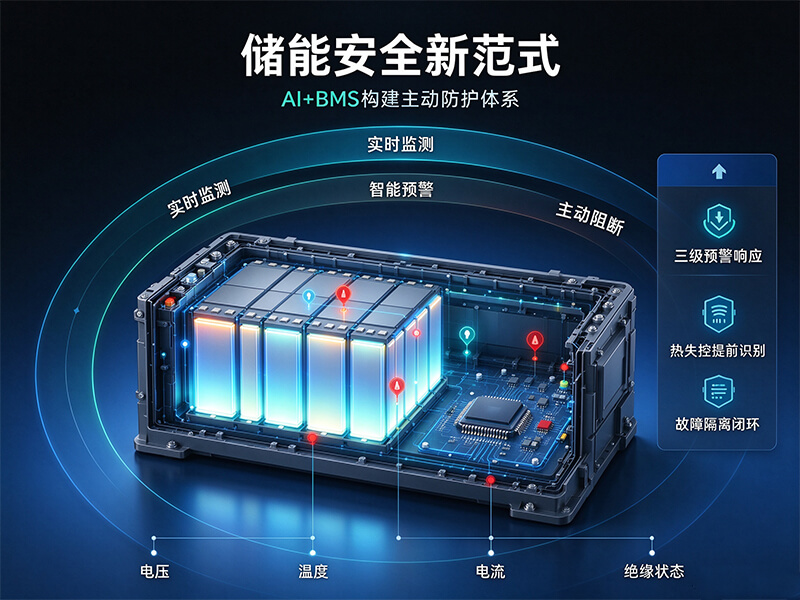
据36Krypton reported, active immunizationBMSTechnology is becoming the new direction of the industry. The technical path is divided into three steps: first, full-link monitoring, real-time collection of voltage, temperature, internal resistance and other parameters of each cell; The second is intelligent repair, which adjusts the charging and discharging strategy through algorithms when the risk is controllable, and balances and repairs abnormal cells. Finally, it is forced to block, forcibly cut off the charging and discharging circuit when the risk deteriorates, and completely block the occurrence of thermal runaway from the physical level.
This kind“Monitoring-Fix-Block”The closed-loop system of the battery safety management after the remediation to a new level of pre-prevention.
5. Three-level early warning response mechanism
A new generation of intelligenceBMSThe three-level early warning response mechanism is generally adopted: the first-level early warning focuses on early anomalies and adjusts them through algorithm optimization; the second-level early warning focuses on moderate risks, strengthens monitoring frequency and adjusts operation strategies; the third-level early warning focuses on serious risks, immediately cuts off the circuit and starts emergency plans.
6. Industry Standards and Codes
With the development of energy storage safety technology, the relevant standards are constantly improving.2026The group standard of "safe and intelligent longevity lithium battery for energy storage" released inBMSSecurity requirements:
overcharge protection:BMSShould be in the monomer voltage exceeds the set threshold,50Milliseconds to cut off the charging circuit and alarm. Protection:BMSWhen the monomer voltage is lower than the set threshold,50Discharge circuit shall be cut off within milliseconds and alarm shall be given. Over-current protection: when there is over-current in the charging and discharging circuit, the circuit shall be cut off within the specified time and alarm shall be given.
The formulation of these standards provides clear technical specifications and acceptance basis for the safe operation of energy storage batteries. For battery companies and system integrators, meeting these standards has become the basic threshold for market entry.


